Workforce Intelligence Platform
Turn Workforce Demand Into a Smarter Hiring Campaign.
Laddershot helps employers anticipate execution-critical hiring needs, identify where military experience can meet them, and build qualified talent pipelines before workforce pressure becomes an operating constraint.
We combine company analysis, military-ecosystem intelligence, targeted sourcing, and candidate preparation to make each hiring campaign more focused, timely, and effective.
Built for employers operating where timing, readiness, and execution matter.
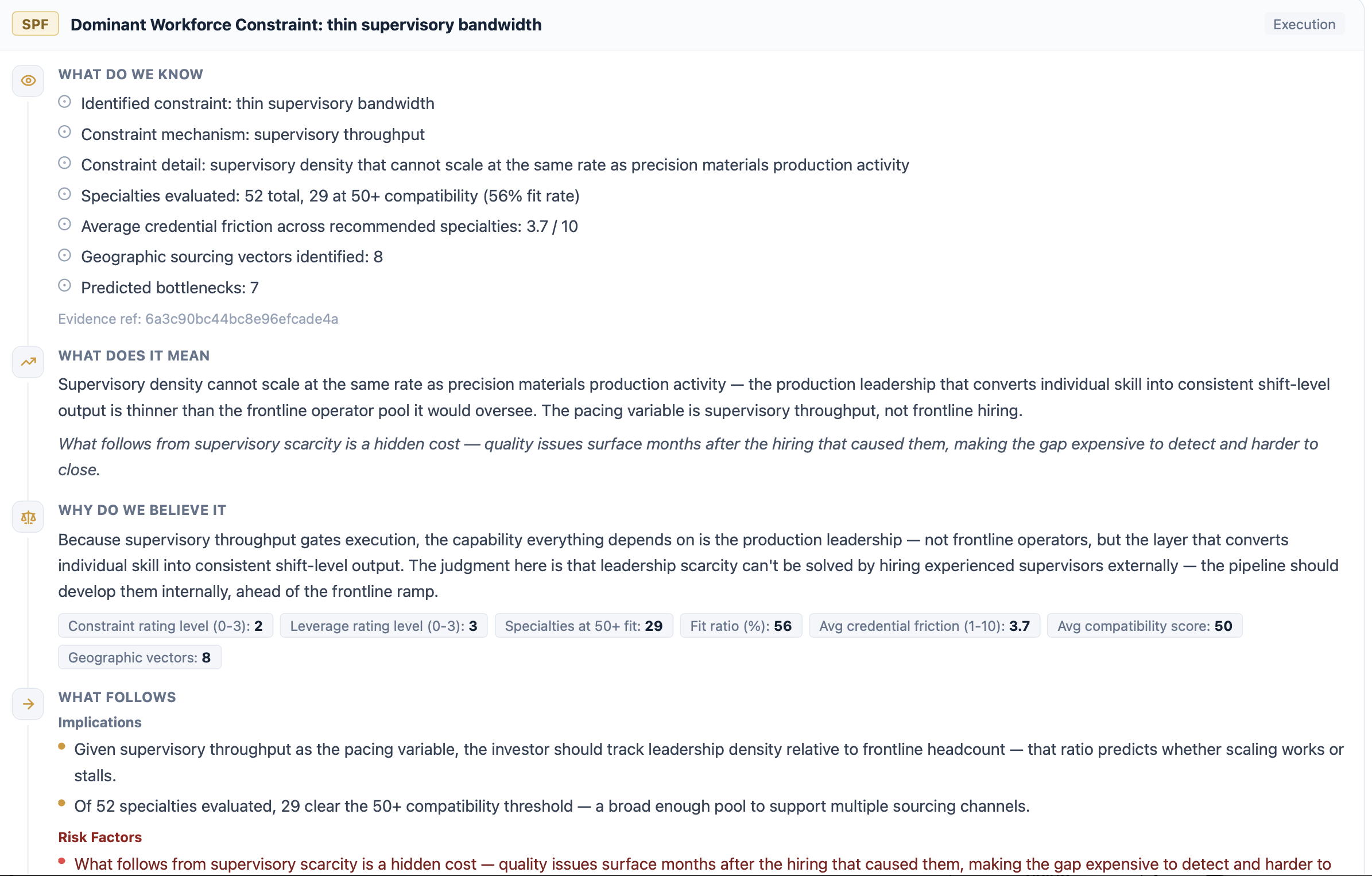
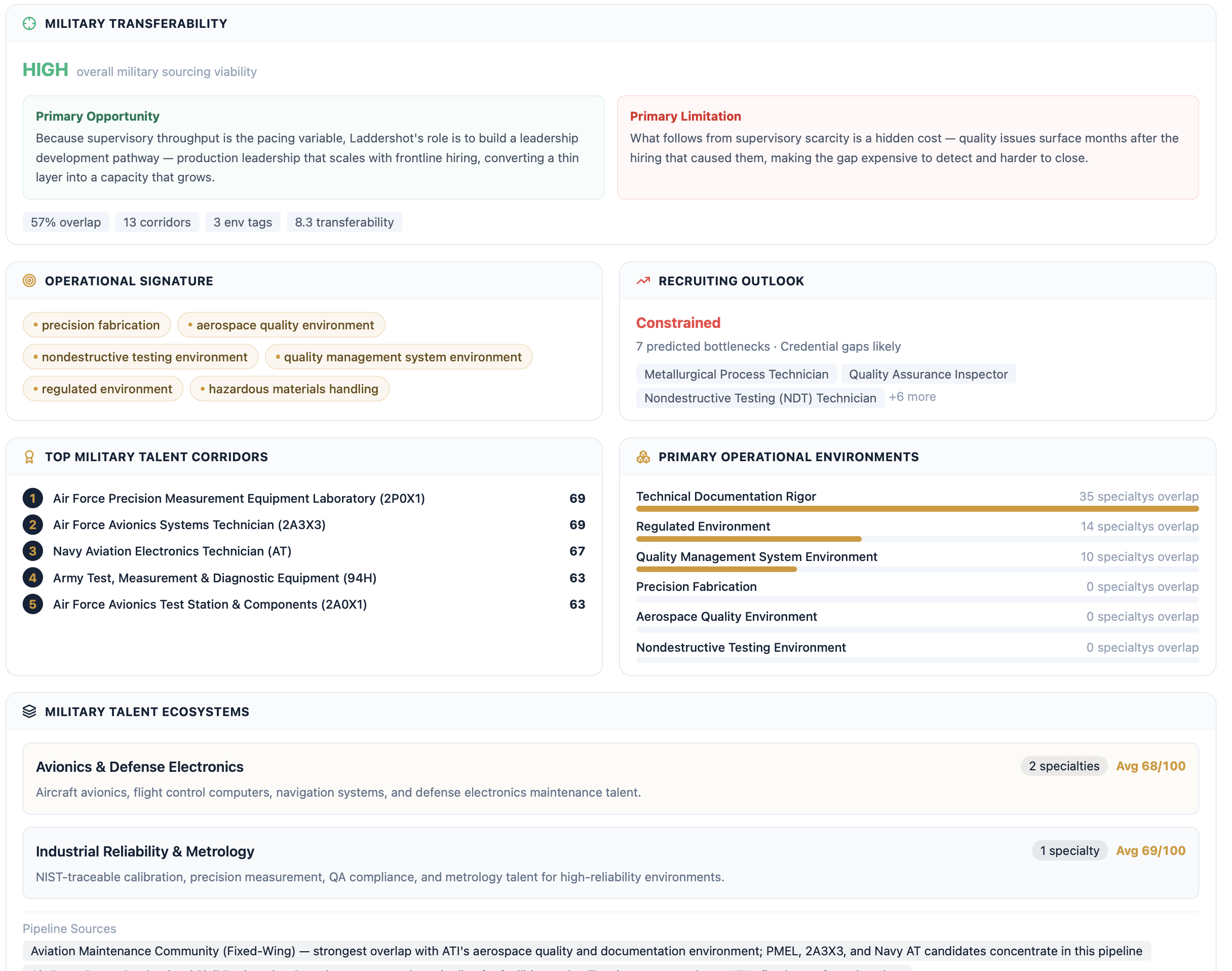
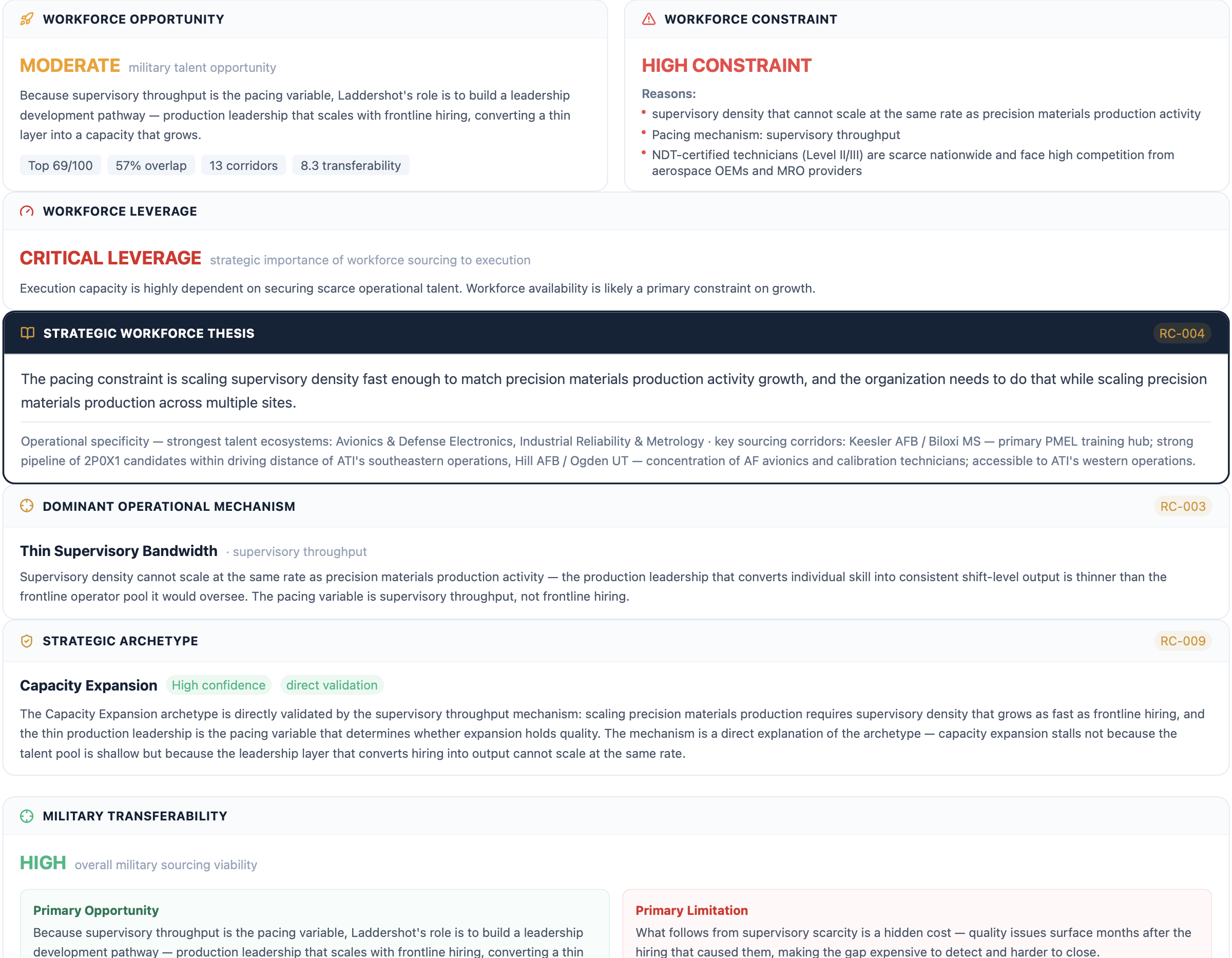
A glimpse inside the Prospector — example analysis views.
A Requisition Tells You Who Is Open. It Does Not Tell You Who You Will Need.
Traditional recruiting often begins after demand has already become visible. Laddershot looks further upstream—at the growth plans, operating conditions, workforce structure, and execution pressures that create hiring demand in the first place.
Demand Arrives Late
By the time a role becomes urgent, timelines may already be at risk and the most relevant candidates may not yet be identified, engaged, or prepared.
Job Titles Hide the Real Requirement
Two positions with similar titles can require very different technical experience, operating discipline, credentials, leadership capacity, or readiness.
Strong Talent Is Often Overlooked
Military candidates may possess highly relevant capabilities even when their titles, terminology, and career paths do not resemble their civilian counterparts.
The hiring campaign should begin with the operating need—not just the open role.
We Connect the Business Need to the Talent Market.
Laddershot uses workforce intelligence to translate what the employer needs to execute into a more precise understanding of who to find, where to find them, how to engage them, and what preparation may be required.
Understand the Demand
We examine the employer's growth plans, operating environment, locations, timelines, execution-critical functions, and current workforce pressure.
Translate the Requirement
We identify the capabilities behind the role—not simply its title—and determine which military experience patterns may transfer directly or with targeted preparation.
Find and Prepare the Talent
We source across relevant military, veteran, and adjacent talent populations, prioritize likely-fit candidates, and prepare them for the employer's requirements and hiring process.
Activate the Campaign
We infuse the analysis into sourcing priorities, outreach, candidate qualification, pipeline timing, and ongoing employer engagement.
Analysis becomes a hiring advantage only when it changes how the campaign is executed.
From Workforce Signal to Candidate Pipeline
Analyze the Company
We develop a working understanding of how the company operates, where it is growing, what it must execute, and which workforce conditions may affect that execution.
Examples of relevant signals may include:
- —expansion and capital deployment
- —new facilities or operating locations
- —contract awards and delivery commitments
- —production or service growth
- —hard-to-fill role patterns
- —credential and clearance requirements
- —supervisory or technical capacity
- —geographic labor constraints
Identify Priority Roles and Capabilities
We determine which roles and capabilities have the greatest relationship to the employer's immediate and anticipated execution needs.
The analysis goes beyond job titles to consider:
- —technical work performed
- —operating environment
- —equipment and systems experience
- —leadership scope
- —safety and compliance
- —maintenance and logistics responsibilities
- —credentials and clearances
- —geographic requirements
- —time required to reach readiness
Map the Military Talent Opportunity
We analyze where military occupations, assignments, training, and experience may correspond to the employer's actual requirements.
This is not a simplistic title-to-title match. We distinguish among:
- —directly transferable experience
- —structurally compatible experience
- —experience requiring civilian credentials
- —experience requiring bridge training
- —leadership or operational capability that transfers across domains
- —cases where no responsible equivalence should be claimed
Build the Candidate Strategy
We convert the analysis into a practical sourcing and campaign strategy, including target populations, candidate profiles, geographic priorities, qualification criteria, outreach positioning, transition considerations, and pipeline timing.
Source, Engage, and Prepare
We identify and engage relevant candidates, assess their likely fit, explain the employer opportunity in language that connects to their experience, and prepare qualified talent for the hiring process.
Learn and Refine
Campaign response, candidate progression, employer feedback, placement experience, and workforce outcomes can improve future targeting and preparation.
Learning is a disciplined feedback loop—not automatic proof of every initial assumption.
Military Talent Is More Than a List of Occupational Codes.
Finding the right military talent requires understanding how people are trained, how responsibilities differ across services and assignments, how experience develops over a career, and what must change during the transition into a civilian operating environment.
Laddershot uses that understanding to help employers recognize relevant capability that conventional recruiting filters can miss.
Experience Translation
We translate military responsibilities, systems, environments, and leadership experience into the capabilities relevant to the employer's work.
Transferability Boundaries
We identify where experience transfers responsibly, where credential or training gaps remain, and where apparent similarity does not establish real fit.
Talent-Pool Precision
We narrow sourcing toward the services, occupational communities, experience levels, locations, and transition profiles most relevant to the campaign.
Candidate Positioning
We help candidates communicate their experience in terms employers can evaluate while preparing them for the expectations of the civilian role.
The objective is not to place military talent everywhere. It is to identify where military experience can create a genuine execution advantage.
Build the Pipeline Before the Hiring Pressure Peaks.
Laddershot looks for signals that workforce demand may be forming before every requirement appears as an urgent requisition.
By connecting company growth, operating requirements, workforce architecture, and talent-market conditions, we can help employers determine:
- —which roles may become difficult to fill
- —where qualified supply is likely to be constrained
- —which military talent populations may be relevant
- —how long sourcing, credentialing, or transition may take
- —when candidate engagement should begin
- —where a forward pipeline can reduce execution risk
We do not wait for demand to become urgent before determining where the talent may come from.
Forecasts and candidate priorities are evidence-informed assessments, not guarantees. They help focus action earlier and improve as employer and campaign evidence develops.
Intelligence Infused Into Every Stage of the Campaign
Role Prioritization
Focus recruiting effort on the roles and capabilities most closely connected to employer execution.
Candidate Profiling
Define likely-fit candidate profiles using relevant experience, environment, responsibility, readiness, and transferability—not keywords alone.
Targeted Sourcing
Search the military and veteran ecosystem with greater precision across service backgrounds, occupational communities, experience levels, and locations.
Relevant Outreach
Connect the employer opportunity to the candidate's experience, motivations, transition timing, and potential civilian career path.
Candidate Preparation
Help candidates translate their experience, understand employer expectations, and address identifiable readiness or credential gaps.
Pipeline Management
Maintain visibility into candidate readiness and campaign progress so the pipeline can support immediate requirements and anticipated demand.
More Than Candidates. A More Intelligent Path to Them.
The platform helps Laddershot give employers a hiring campaign grounded in the realities of the business, the role, and the talent ecosystem.
The goal is not more recruiting activity. It is better-directed recruiting activity.
Designed for Hiring Demands Where Execution Matters.
The Laddershot approach is particularly valuable when roles are difficult to source, operating environments are complex, hiring timelines affect deployment, or conventional recruiting methods fail to recognize transferable experience.
Technical and Skilled Operations
Examples include: Maintenance, field service, manufacturing, production, systems operations, and equipment-intensive work.
Deployment and Logistics
Examples include: Supply chain, logistics, transportation, field deployment, inventory, and operational coordination.
Safety, Compliance, and Mission-Critical Work
Examples include: Roles requiring disciplined execution, procedural rigor, safety awareness, clearances, or regulated operating practices.
Frontline and Operational Leadership
Examples include: Supervisors and leaders responsible for readiness, teams, schedules, assets, and execution under pressure.
Focused by Intelligence. Grounded by Evidence.
Laddershot distinguishes between what is known, what the available evidence suggests, and what remains uncertain.
That discipline helps us avoid false equivalence, unsupported candidate claims, and unfocused sourcing. It also allows the hiring strategy to improve as employer input, campaign evidence, and real outcomes become available.
Evidence Before Assumption
Candidate and workforce conclusions should remain connected to the information supporting them.
Fit Without False Equivalence
Military experience is evaluated for relevant capability, transferability, readiness, and remaining gaps—not treated as automatically interchangeable with civilian experience.
Learning Over Time
Employer feedback and campaign outcomes inform future sourcing and preparation without being treated as automatic proof of every earlier conclusion.